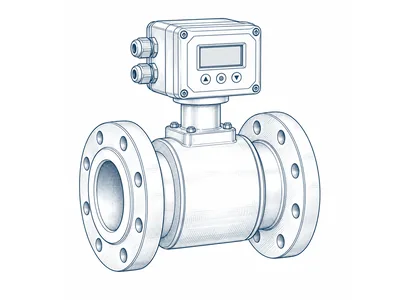
Advantages: no measuring rotor; options for water and conductive wastewater; digital flow and totalization; analog and digital integration. A full-bore design can have low additional pressure loss.
Limitations: the fluid must meet the model's conductivity requirement. Conventional full-pipe versions need a full measuring tube. Liner, electrode, grounding and power choices matter.
Before buying: specify the lowest expected conductivity, solids and chemical content, liner and electrode materials, full-pipe conditions and the exact power/output combination. A battery model may not provide the same continuously powered outputs as a mains model.
Do not apply one catalogue's conductivity threshold to all electromagnetic meters. Specialist designs also exist for partly filled pipes, but these incorporate additional measurement capabilities and must be selected specifically. KROHNE electromagnetic range
Common mistake: specifying an ordinary mag meter for ultrapure water because “it is still water.” Measure conductivity under the actual process conditions before accepting that choice.
What to specify for this type
- Lowest measured conductivity
- Liner, electrode and seal compatibility
- Full measuring tube, grounding and pipe profile
- Integral/remote configuration, accuracy basis and simultaneous powered outputs
Flow range and communications
Match actual minimum, normal, continuous maximum and peak flow to the exact configuration. A shared pipe size does not establish equivalent performance.
A connected metering system is five parts: meter → interface or module → network or gateway → software → billing, dashboard or control system. A quotation should name who supplies and maintains each one. AMR-ready equipment may still require separately quoted radio, gateway, head-end and billing software.
Read the detailed measuring-principle guide · Understand sizing and accuracy · Compare communication options